


Christian Bennett has written a manuscript analysing the Mr Cruel crimes. This manuscript was originally written in 2014 and has been updated several times. He has provided the manuscript to the Victoria Police. It has not been published previously on the internet. Clinton has given me permission to publish sections of it here. This chapter of the the manuscript deals with the connections between Presbyterians and the offender.
https://pagead2.googlesyndication.com/pagead/js/adsbygoogle.js?client=ca-pub-5770274055470368
Melbourne Marvels would like to preface the inclusion of the below chapters from Bennett’s manuscript by stating our reasons for publishing these sections. Bennett proposes several theories as to the motive of the offender known as Mr Cruel. These are that perhaps he held a grudge against things Presbyterian, or against someone in this church or one of its offshoots. Melbourne Marvels finds these propositions to be highly unlikely, however, feels these sections are worthy of publication because of the excellent research carried out by Bennett. We also feel that, the associations between some of the Mr Cruel crimes and the Presbyterian Church could perhaps be better explained by a more simple proposition: perhaps the offender was in some way connected to one of the main branches of the Church. Furthermore, we feel that the information these sections provide on the convicted sexual offender and murderer Robert Arthur Selby Lowe are of great interest to the reader interested in the Mr Cruel case.
38 PRESBYTERIANS and THE OFFENDER
DID THE OFFENDER STAGE A VENDETTA AGAINST PRESBYTERIANS?
The concept that the offender, known as Mr Cruel, was staging some sort of vendetta against the Presbyterian Ladies College (PLC) in Burwood is hardly an original idea. After all, two of the College students were abducted from their homes, with one being assaulted and another murdered and possibly sexually assaulted as well.
The vendetta angle, possibly revenge for a perceived slight, would have been one of the first things detectives would investigate. PLC supplied a long list of people they had dealings with, and this would include those involved in the invariable dispute or complaint (legitimate or otherwise) that arise when running a school.
The idea that Mr Cruel had some sort of general loathing of things Presbyterian and was conducting some sort of campaign against them is harder to conceptualise. Anti-Semitism, as in hatred of Jewish people, is something most people are aware of, as in the Holocaust of the past, and present day attacks on synagogues and terrorist attacks on Jewish people.
A Google search will also produce a large quantity of hits for “anti-Catholic” and / or “anti-Protestant”.
By contrast, “anti-Presbyterianism” didn’t raise a hit. As a concept it would appear almost the stuff of macabre satire. Generally speaking, Presbyterians don’t excite much interest and until quite recently have been included in Australian census data under the cover-all title of “Other Protestant Denominations”. Catholics and Anglicans have always had their own sections.
However, given his behaviour towards two students from PLC, some sort of campaign against Presbyterians in general cannot be ruled out. Two is not a huge sequence, but the obvious planning that went into both kidnappings suggests something beyond a physical motive.
There is also an internet blog suggesting that Sharon Wills had a first cousin who attended PLC. At the moment the writer is unable to confirm the veracity of this piece of information but if true, this potentially increases the sequence to three.
So now we come to look at what circumstantial evidence there is that the offender may have had some connection with the Presbyterian Church – whether as a member, or as an embittered ex-member, or as someone who held a grudge against that particular Church and its members.
At first it would appear that there would be no physical circumstantial evidence of any sort of connection but there does seem to be some interesting coincidences.
PRESBYTERIAN GRAVEYARDS
The writer has already postulated that the offender may have used a number of cemeteries for his surveillance of crime scenes. However, when the writer looked at actual maps of these cemeteries, his attention was drawn to something that could be quite significant.
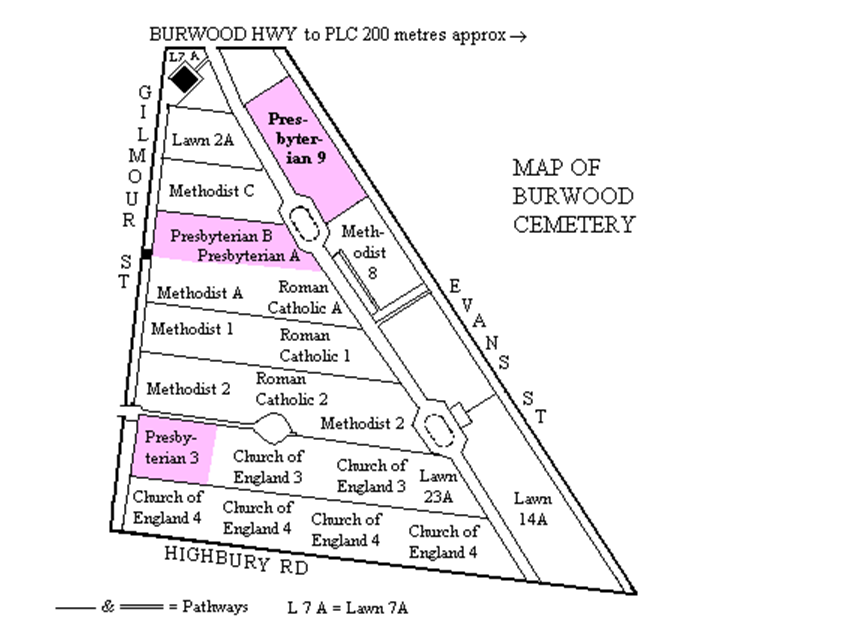
If the offender known as Mr Cruel was using Burwood Cemetery as a surveillance area for Presbyterian Ladies College students arriving and departing from the school, then he would most certainly have chosen the Burwood Hwy side. Of interest is that the Presbyterian graveyard section of Burwood Cemetery dominates the northern portion of this site.
This by itself would probably not be particularly significant. The cemetery is dominated by the four major denominations of pioneer settlement i.e. Church of England, Presbyterian, Methodist and Roman Catholic. The cemetery is now fully occupied with no new burial places. Not surprisingly it is a favourite among a small group of students of local history.

Templestowe Cemetery
Presbyterians occupy a small but significant corner of the Templestowe Cemetery. Roman Catholics and Church of England have their own significant areas, but in this case Methodists (and possibly it’s successor, the Uniting Church) are listed under Other Denominations (as well as “Other D” on the map). The Lutherans have a presence probably from the earliest days of settlement.
It has been suggested by the writer that the offender, Mr Cruel, possibly used the Templestowe Cemetery for surveillance of the Church Rd area south from the cemetery. This is the place where Karmein Chan had her home, on the corner of Church Rd and Serpells Rd. From the cemetery corner, near the intersection of Foote St and Church Rd he would have had an uninterrupted view south, straight up the hill to the place where she lived.
The Presbyterian graveyard or section borders the internal cemetery road called Hunter Av which runs parallel to Foote St, and at first, it would seem that this part of the cemetery would not be as significant as a place nearer Church Rd i.e. the Harle Lawn section.
However, from the point of view of monitoring traffic, at night, that turns in and out of Church Rd from the south of Foote St and the continuation in Reynolds Rd, the Presbyterian section offers the best concealment. Even at night the Harle Lawn area, would mean that potentially the offender may be spotted from four different angles. The Presbyterian Monumental area, not only provides grave stones and other hiding places, but the offender if he has his back to the cemetery side fence on the west side, can only been seen from one side. Given this, on a moonless or overcast night, the offender would have been virtually invisible.
From the Presbyterian graveyard section, the offender potentially could have monitored not only the traffic, but before the road works circa 1990, also the Chan family car if they used the Foote St – Church Rd intersection to turn south towards their home near the top of the hill.
By the time the writer came around to finding a map of the Kew cemetery – near where Nicola Lynas was released in 1990 – he had a “hinky” feeling that the nearest significant graveyard section that would be closest to the crime scene, would be the Presbyterian section.
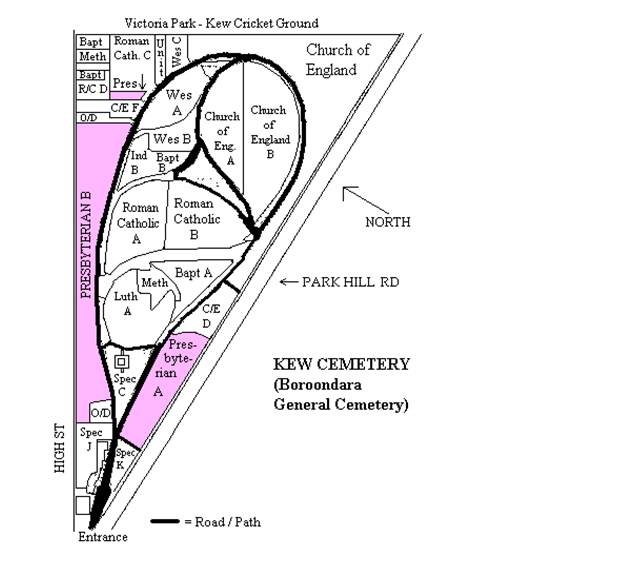
The Presbyterian section of the Kew Cemetery – also known as the Boroondara General Cemetery – dominates the High St side, which is the street that’s closest to the Eglinton St and Tennyson St area where Nicola Lynas is reputed to have been released.
The Presbyterians occupy a greater area in the cemetery than their numbers in the past would suggest as a percentage of Australian Christians, but would reflect a very strong local presence. This will be discussed later, but it is no real surprise that on either side of the Kew Cemetery, along High St, within a kilometre, were once three Presbyterian churches.
Given the apparent planning that went into the offender’s crime with regard to Nicola Lynas, it is not totally unreasonable to suggest that he may have lived in the area at once stage, or at the very least had something to do with the suburb of Kew i.e. work, or even being involved socially.
The Kew Cemetery itself has the usual preponderance of Church of England (Anglican) sections but Wesleyan sections suggest a strong link with the Methodist church. Baptists and Lutherans are also represented.
Of interest is a large memorial to David Syme (1827-1908), the man who saved The Age newspaper from insolvency in the 1860s and made it into what was then a great liberal newspaper and institution. Syme was raised a Presbyterian but revolted against its Calvinistic teachings of the day. Syme and The Age championed manhood suffrage, land reform, free and secular education, and protectionism for industry.
Whether the man know as Mr Cruel supports these or similar views is an open question, but circumstantial evidence would suggest that the offender had an interest in newspapers that was greater than that of merely an average reader.
A cynic may suggest that it is merely coincidence where Presbyterians bury their dead when it comes to Mr Cruel but it is not totally unreasonable to suggest that there may be some connection, even if it is the offender laying another red-herring.
However, when it came to the selection of one of his victims – in the case of Nicola Lynas – and the siting of the crime, Presbyterian churches may have some connection. Committing a crime near a Presbyterian church is something that the offender has some control over in terms of topography.
The following example is given:
PRESBYTERIAN CHURCHES IN RELATION TO CRIME SCENES
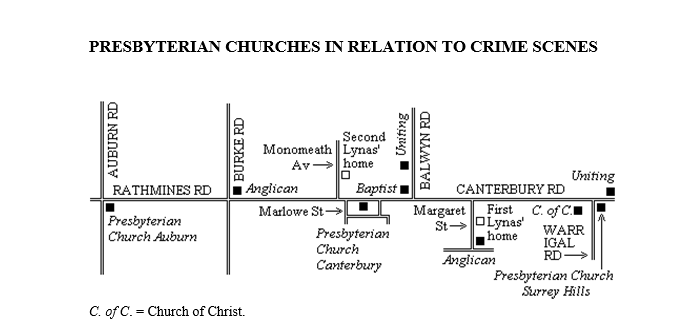
The above map represents approximately the 4 kilometres covered by Rathmines Rd-Canterbury Rd between Auburn Rd in Hawthorn East to just past Warrigal Rd in Surrey Hills.
Not surprisingly all the major Protestant denominations are listed, including a Church of Christ (C. of C.). While all churches along Rathmines Rd-Canterbury Rd are listed, a few minor denominations close by have been omitted. These are the Armenian Apostolic, located in Norfolk Rd, between Margaret St and Warrigal Rd. and a Seventh Day Adventist Church, some distance from Rathmines Road in East Hawthorn.
A quick look at the map would suggest that if this pattern was replicated throughout Australia, then the Presbyterian Church would be the dominant Protestant denomination, if not the largest Christian community. But this is more than a mere statistical aberration, for it reflects the conservative nature of the area in that these individual churches didn’t join the Uniting Church in 1977 when two-thirds of the old Presbyterian Church of Australia did.
The map also shows the location of the first place of residence for the Lynas family (c. 1987-1990) and the second temporary location (1990) while they were planning their eventual return to England (in July 1990).
Just up from their first home in Margaret St is an Anglican church. Mr Brian Lynas was very much an establishment type person (MCC member who followed Melbourne Football Club). Whether they were actual church goers or not is unknown. He may have chosen PLC for his daughters’ education probably because it was moderately close by and for its good academic reputation.
The Lynas’ first home is just about halfway between the Presbyterian Church in Surrey Hills and the Presbyterian Church in Canterbury. The second Lynas home in Monomeath Av is quite close to the Presbyterian Church in Canterbury.
A point to note is that while all three Presbyterian churches are substantial buildings, the one in Canterbury is almost approaching cathedral size. The complex there almost speaks of a time when it was really important, possibly an administrative centre. There is even a tennis court.
It is this Presbyterian Church in Canterbury which may have found its way into the possible planning by the offender, known as Mr Cruel when he kidnapped Nicola Lynas near midnight on a Tuesday night on 3 July 1990.

It is on the public record that the offender known as Mr Cruel, kidnapped Nicola Lynas, stole the Lynas’ family car, drove it around for several minutes (possibly to disorientate his victim), dumped the car in Chaucer Cres, and then transferred his victim to another vehicle (possibly also stolen) and took her to a prepared hideout possibly in the northern suburbs.
That much is known. But it is also the contention of the writer that the offender may have been planning to walk his victim from her home in Monomeath Av to his getaway car in Chaucer Cres in the event that he couldn’t steal the Lynas’ family car.
As evidence of his mindset here, Mr Cruel allegedly ordered Nicola Lynas, while he was inside her home, to get her Presbyterian Ladies College blazer, tunic and runners. Note he didn’t appear to request that she get her leather school shoes.
It’s one thing to drive a kidnap victim around for several minutes, it’s quite another to walk some distance with them. A feature of Mr Cruel’s crimes is that he was prepared to walk 200-300 metres with his victims but it must be noted, in a direct route to where he most likely intended.
In Nicola Lynas’ case, this would have been south along Monomeath Av, then crossing Canterbury Rd, a short walk east to Marlowe St, then south (possibly on the east side which has no footpath) down Marlowe St, passing an unnamed alleyway, to Chaucer Cres to where his car was nearby. (Circumstantial evidence suggests that the offender included unnamed roads, paths and alleyways in his plans).
Not only is this plan the most logical way, it is by far the shortest route. And this is something the map doesn’t tell the reader. Most of the houses that he would have passed would have been on the sides of their property. Only some four or five would have directly faced his flight route. The houses across the road, even if an occupant could see him, could have looked for all the world at 11.30 pm on a cold winter’s night, like a nondescript couple making their way home from some function.
At first sight the map of the Presbyterian Church location in Canterbury doesn’t suggest anything much in the way of the planned crime.
One thing that police almost universally agree upon is that the crimes of Mr Cruel are extremely well-planned.
The writer would concur with this view. It is here that the possible planning of the offender may be deduced.
Had the offender felt the need to walk his victim, Nicola Lynas, from her home to his getaway car, what would he do if police sirens and lights suggested that the kidnapping had become possibly known to them?
One course of action that springs to mind is that if he was in Marlowe St, abandoning his victim, exiting down the unnamed alleyway, and heading for the grounds of the Presbyterian Church in Canterbury makes sense.
From recent aerial photographs it would appear that a number of properties may have annexed bits of the alleyway that runs off Marlowe St and between Canterbury Rd and Chaucer Cres. Trying to navigate these with the idea of eventually getting back to Chaucer Cres doesn’t seem practicable. However, climbing one or two fences to get to the grounds of the Presbyterian Church located nearby seems a much better option.
Back in 1990, in order to plan something like this, the offender would have to have known the area or at least visited here to grasp such things. It’s quite possible that he visited the Presbyterian Church and / or its grounds some time prior to this.
It’s interesting that a local council property map has the unnamed alleyway being officially a passable lane for some three properties distance, then it lists it as an easement for the rest of its journey. Some 50 to 100 years ago it was probably totally navigable due to such services as the toilet pan collection of the night cart, which would need to access the back of home properties. Changing technology would make such things obsolete.
Please note: The map of the Presbyterian Church Canterbury location area is based on today’s maps. While most of the homes in the area would be more or less as they were in 1990, the unit complex to the east of the Presbyterian Church is very modern looking and may not have been there in 1990.

The circumstantial evidence for Presbyterian graveyards and churches is starting to mount up. But there is one other thing to note.
Currently there is a Presbyterian church listed in Tennyson St, Burwood. It has previously been listed as some sort of local administrative centre and now is the official home of the Presbyterian Chinese Church of Burwood.
At a distance of some 2 km from PLC it doesn’t seem much of a clue, even though the church is located in the Burwood suburb.
However, the offender is known for laying false trails and red-herrings. This has been tantamount to taunting police investigators of his crimes.
The fact that this church is in Tennyson St, Burwood, is of some significance since the offender released Nicola Lynas in or near another Tennyson St (but this time in Kew).
Also of interest, but in a suburb much further away, there is another Presbyterian church located in Tennyson St, this time in Elwood. The arrangement of this Tennyson St, Byron St disrupts, closely matches the disruption to Chaucer Cres in Canterbury, where the offender had placed his getaway vehicle.
In 1990 there were some 25 Tennyson streets, avenues, courts etc in the Melbourne metro area. A hunt through the Melway Street Directory only produces two churches for all these locations, and both are Presbyterian. In Moonee Ponds there is a Presbyterian church in the street next to Tennyson St, located in McPherson St.
FORMER PRESBYTERIAN CHURCHES
As previously mentioned, two former Presbyterian churches, located a short distance either side of the Kew Cemetery, joined the Uniting Church in 1977.
In 1988, the offender released Sharon Wills near Church St, in Bayswater. Across the Mountain Hwy, in Bayswater, just down from Church St, is a Uniting Church located in Elm St.
This looked as if it just might fit the pattern, but a source within the Presbyterian Church of Australia has pointed out that this particular church had never been part of the previous Presbyterian Church prior to two-thirds of the membership voting to join the Uniting Church in 1977.
This does not rule out a connection but unless there is other evidence to support this, as a clue it would have limited value.
KEW PRESBYTERIAN CHURCHES JOIN THE UNITING CHURCH
While on the subject of Presbyterian churches joining the Uniting Church in 1977, it is worth noting what took place in the Kew area, near where the offender released kidnap victim, Nicola Lynas, in 1990.
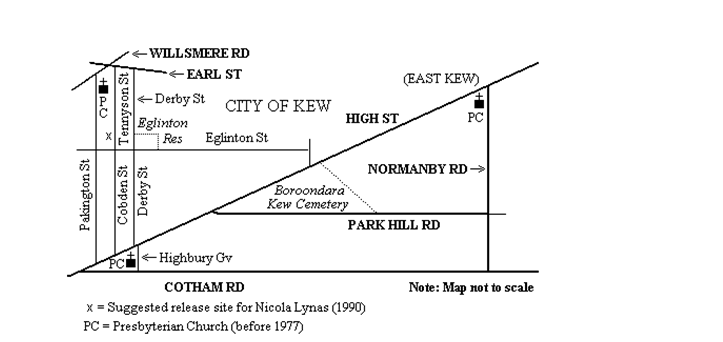
According to past editions of the Melway Street Directory, before 1977, there were three Presbyterian churches in the City of Kew. All of these churches voted to join the Uniting Church in the 1977 merger of Methodists, Congregationalists and Presbyterians.
This left the City of Kew without a Presbyterian church and to this day this arrangement has been in place. Chances are that approximately a third of each Presbyterian congregation would have opposed their individual church moving to the Uniting Church, then over half a congregation worth of members would have been disenfranchised.
How these members would take it would range from great bitterness to resignation to the inevitable. Rusted on Presbyterians of Kew could, of course, travel to a suburb relatively nearby and continue to attend one of the churches that made up the PCA from 1977 onwards.
A person driven to seek revenge for this new arrangement would, on the surface, be more likely to take out their frustration on the Uniting Church, but this notion doesn’t discount the possibility of them being more angry with those Presbyterians who voted for the merger.
The map of Kew detailing the three previous Presbyterian churches is interesting in that the previous Presbyterian church at Highbury Grove (now a Uniting Church) is almost in a straight line with Derby St that leads to Eglinton Reserve in Eglinton Street, Kew. This is where some allege that Mr Cruel parked his vehicle and then walked Nicola Lynas round to Tennyson St, then released her there (“x” on the map).
NOT ONLY KEW PRESBYTERIANS BUT SUBURBS NEARBY
If Presbyterians in the City of Kew felt aggrieved that all three of their Presbyterian churches voted to join the Uniting Church in 1977, then their countenances would not have been improved by the next nearest Presbyterian church, located in Deepdene (Balwyn) also voted to join.
This church was formerly the Frank Paton Memorial Presbyterian Church on 958 Burke Rd, Deepdene (Balwyn). It was located next to the Deepdene Primary School.
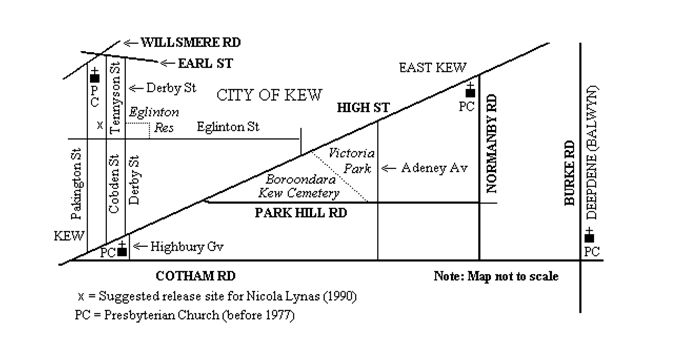
Before 1977, a Presbyterian churchgoer living on the corner of Adeney Av and Cotham Rd, would have had, within a little over a kilometre, five Presbyterian churches to choose from. The four on the map and another to the south in Auburn.
In fact, from this location, one could walk in more or less a straight line, north or south, east or west, to a Presbyterian church without necessarily seeing another denomination’s church along the way. If one was to disingenuously use the area as a typical snapshot representing Australian Christianity in general, then Presbyterianism would be the dominant force.
Of course, this is not the case, but a case can be made for Kew and surrounding area being once a Presbyterian stronghold. The number of churches and graveyard sections might appear to be a rather crude indicator, but probably is a reasonable reflection on the hold the old Presbyterian church once had on the area.
After 1977, all four Presbyterian churches on the map became members of the Uniting Church.
A staunch Presbyterian who say lived near the corner of Adeney Av and Park Hill Rd, who once had four churches to choose from within walking distance, would suddenly find that at the stroke of a pen, find their worship options severely restricted.
CANTERBURY STAYED PRESBYTERIAN; KEW WENT UNITING CHURCH
By now the reader will have realised that both Canterbury and Kew were once significantly represented by the Presbyterian Church. Some might even say, over represented.
Here are two comparable established areas, in terms of wealth and desirability. These two areas are also moderately close to each other. Yet, one area’s Presbyterian churches voted to join the Uniting Church, while the other voted to stay Presbyterian.
Why this happened is hard to explain. In fact, it may get down to the personalities of the leading figures of each individual church at the time (1977). This would include Presbyterian ministers along with elders of the church etc. It’s quite possible that even the individual congregations or the State governing bodies of the present day Uniting Church or Presbyterian Church of Australia would not know the answer to this.
SIGNIFICANCE OF THE LOCATION OF CHURCHES IN TWO CRIMES
The location of a Uniting church, at Highbury Gv in Kew, near where the offender released Nicola Lynas (1990), in itself, would not be particularly significant if it wasn’t for the fact that there was a Uniting church, not far from Church St, Bayswater, where the offender released Sharon Wills (1988), just behind Bayswater High School.
Added to this, is that both Uniting churches are more or less the same distance from the release locations of two of the offender’s kidnap victims.
But that’s not the only similarities. Both Uniting churches are located due south of the crime scenes. And with both churches, any offender would have cross a mjaor road to get to the minor road that leads to the crime scene. Both these major roads travel in a North-East direction (although High St, Kew, is a truer example of this).
CONCLUSION – WHAT TO MAKE OF ALL THIS?
Despite all the above material, the writer still feels that the offender is more likely to have some sort of grudge – real or imaginary – against the Presbyterian Ladies College rather than Presbyterians in general.
He did after all kidnap two PLC students and there is no record of any other kidnapping of Presbyterians. Certainly no Presbyterian ministers or elders!
What cannot be ruled out is that this apparent grudge against PLC could manifest itself in other ways i.e. Presbyterian graveyards facing crime scenes; etc . The circumstantial evidence for the offender leaving false clues and crime scenes that may have hidden meanings is quite strong.
It would be up to the police to determine whether any of this matches existing evidence which is in their possession.
ADDITIONAL NOTE – THE PLC CHURCH AT PAKINGTON RD, KEW
When the writer was researching this section in 2015, he completely missed the former PLC Church at Pakington Rd, Kew, as it’s now listed as the North Kew Kindergarten (Inc.), and is located at 152 Pakington St, Kew.
Allowance has now been made for this correction both in maps and in the text of this section.
Obviously when the Uniting Church acquired the former PLC Church at Pakington Rd, Kew, it was realised that the area was well serviced by Uniting Churches, so turning it into a kindergarten made sense without unduly inconveniencing its members as there was another Uniting Church nearby in Highbury Gv.
Of real interest is that the former Pakington St Presbyterian Church was listed more or less correctly on the pre-1977 Melway maps but for a time incorrectly sited in the index (locality coordinates listed near the “P” in Pakington and not where the actual church was located.)
This sort of detail is almost typical of the offenders apparent type of planning. For instance, the Presbyterian Church listed in the Melway at the time of the Karmein Chan kidnapping, in 1991, which is the closest church to the main area of the kidnapping (in Serpells Rd and Church Rd), is not listed in its correct position on the Melway map.
The reason for this is that the congregation met inside the Templestowe Park Primary School and it would have been considered inappropriate to place the church symbol inside the school grounds.
That the offender chose an area where the closest Presbyterian / Former Presbyterian Church is not located exactly on a Melway map or in the index, could probably be put down to coincidence, were it not for the fact that numerous examples of the offender choosing crime sites / potential crime sites near where changes or even mistakes had been listed on Melbourne street directories.
A prime example was that the home number of kidnap victim, Karmein Chan, was incorrectly listed in several previous Melway Street Directory editions some years before 1991.
NOTE ON ACCURACY Every effort has been made to make this submission as accurate as possible. For the location of previous Presbyterian churches the writer has relied on the internet and historical copies of the Melway Street Directory and sources within the Presbyterian church and others for information. Any assistance with the correction of facts is always welcome and these will be incorporated into the document as they come to hand.
39 THE POLICE PROFILES AND THE PRESBYTERIAN CHURCH
The reader may feel that the writer has laboured long and hard over attempting to connect cemeteries and Presbyterian churches with the activities of the offender. Of course, the evidence is purely circumstantial.
One reason for investigating this angle is that the police profiles do mention religion.
The FBI profile of the offender, in point 6 and in part reads:
… He may show a short-term interest in religion.
Previously the writer felt this suggestion probably said more about the American profilers than the offender. By contrast Victorian police tended to downplay any such suggestions and the writer cannot find any reference to religion in their published profiles.
But given the number of times a Church road or Street appears near crimes scenes, and given the evidence of churches and cemeteries etc., the FBI may have scored a “hit” here.
If all this sounds somewhat fanciful, the reader should consider this proposition. Does there exist someone who is a renegade Presbyterian who fits much of the criteria of the police profiles?
The following might surprise the reader, but one such criminal comes to mind!
ROBERT LOWE’S CONNECTION WITH THE PRESBYTERIAN CHURCH
He is Robert Arthur Selby Lowe, a former elder in the Knox Presbyterian Church, located in Dandelion Drive, Rowville, and convicted murderer of 6 year old Sheree Beasley.
The list of profile matches is quite staggering:

[PLEASE NOTE: The above was written before the original FBI profile and letter dated 24 April 1991, accompanying it were released in April 2016, persumably by Victorian Police and then presented on the Fairfax website of The Age newspaper. The above FBI profile was generally listed as such in newspapers and was reproduced in books such as Rats – Crooks Who Got Away With It, by John Silvester and Andrew Rule, published in 2006.
The following profile points listed under Profile: Spectrum contain many points listed in the original FBI profile letter but were selectively published in newspapers presumably with the approval of Victoria Police.
The section containing “Other Profile Theories” is considered to be a mixture of police profiles and theories put forward by leading experts such as forensic psychologists, etc.
The key point here is not where all these profile points originate from but the fact that these were given “currency” in newspapers, books and other media.]

Incredibly, Robert Lowe, ticks almost all the boxes on the FBI profile and the Spectrum profile on Mr Cruel. He even had an obsession about the Karmein Chan kidnapping and collected newspaper clippings on her.
He also ticks the boxes for other information released on Mr Cruel i.e.
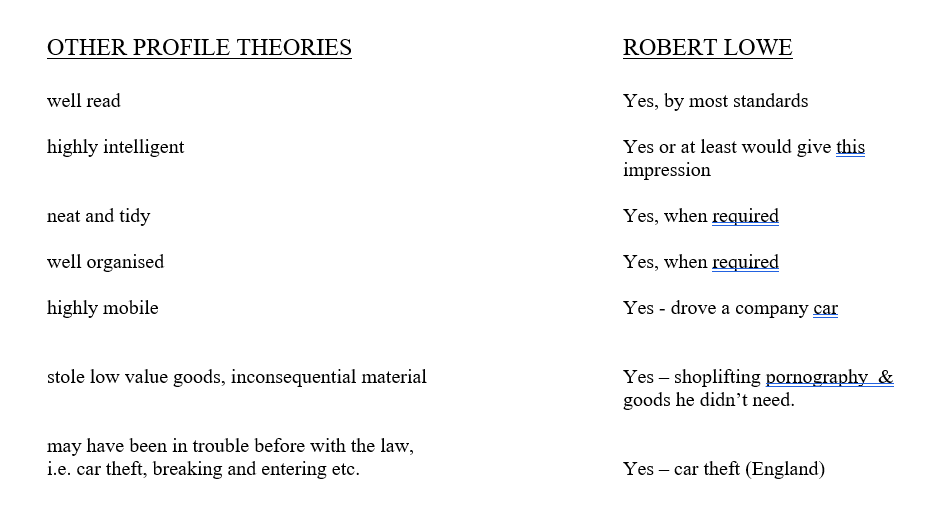
Notable differences with profiles and known behaviour include a certain lack of discipline by Lowe while under suspicion i.e. was reported to have masturbated in a café and also in an alleyway when under police surveillance. Lowe’s surveillance of victims allowed him to be seen and remembered by family members of potential victims and targeted victims. Also Lowe’s alibis were unconvincing and alerted police to his possible involvement in the Sheree Beasley abduction / murder. Lowe’s modus operandi was fairly unsophisticated when compared to that of Mr Cruel. As far as known, Lowe did not break into homes at night.
And there was a critical difference between Lowe and Mr Cruel as to how they acted towards their victims. Mr Cruel apparently sought some sort of personal relationship with those he abducted; the first two cases indicate attempting to engage his victims in conversation, and feeding and washing them. Lowe’s actions toward Sheree Beasley, suggest a much colder, baser relationship without any regard for anything much above power and lust.
The Knox Presbyterian Church was mortified when they discovered the extent of Robert Lowe’s past behaviour and his possible involvement in the Sheree Beasley abduction. With admirable speed, the Presbyterian Church excommunicated Lowe, some five days before he was sacked from his workplace as a sales representative.
Mr Cruel was some sort of hero to Robert Lowe, but it is highly unlikely that Lowe was Mr Cruel. The real question is, if Mr Cruel had some connection with the Presbyterian Church, would Robert Lowe have known him or had some idea as to the identity of Mr Cruel?
Robert Lowe was notable for a long, protracted legal battle in an unsuccessful attempt to prevent his DNA being taken for a match with a much earlier kidnap and rape and murder. This despite there being no connection, but it does suggest that in the future there may be other DNA matches especially as future scientific advances are made.
Robert Lowe’s crimes probably have little to do with his being a Presbyterian. Of course, being an elder in the Presbyterian Church would have given him a veneer of respectability and Lowe was almost certainly capable of using this to advantage. But he was a true Jekyll and Hyde character. His inability to control his more baser instincts led to his undoing on more than one occasion, with a long list of convictions in three countries (England, New Zealand & Australia). He also had an over inflated view of his own abilities and underestimated those in authority.
While the average law-abiding Presbyterian would see someone like Lowe as a modern day Judas Iscariot or worse, being a member of the Presbyterian Church may not have provided him with any motives for his crimes. He was also once a Baptist member.
Sadly, the individual church that Lowe belonged to, didn’t long survive his being a member. His association with the Knox Presbyterian Church at Rowville proved extremely traumatic. According to the Herald Sun of Saturday, 10 December 1994, the residing minister, Ross Brightwell, who once considered himself a friend of Lowe’s, for a time left the church and moved away to the country. His faith was severely shaken.
Membership of the Knox Presbyterian Church dwindled, and few were willing to replace those who left. It was as if the Devil itself had cursed the very ground on which the church at Rowville stood.
ADDITIONAL NOTE ON ROBERT LOWE
As stated, Robert Lowe was unlikely to be Mr. Cruel. He’s slightly taller than the height figures given for the offender. However, a small number of factors do give pause for thought.
Robert Lowe lived at Mannering Drive, Glen Waverley, of which the southern end enters Watsons Rd next to a high voltage transmission line. The writer has theorised that Mr Cruel has some intimate connection with electricity.
He was once an active member of the Baptist Church at High Street, Syndal. Of interest, is that there was Syndal Primary School (now closed) directly diagonally opposite the Baptist Church in High Street, Syndal. Being an active member of this church could mean making visits during school hours, something the average member wouldn’t have need or inclination to do.
The (former) Knox Presbyterian Church in Dandelion Drive, Rowville, doesn’t offer anything remotely like a clue where it’s situated. However, Dandelion Drive could be said to have continued on into Armstrong Drive for those not paying close attention to the road system. This sort of detail would be consistent with the offender, Mr Cruel, who seemed to prefer interrupted roads. Whether Armstrong Drive existed at the time Lowe was an elder with the Knox Presbyterian Church is not known at this point by the writer.
And in fairness to Presbyterians, while Lowe was born into the Presbyterian Church, after coming to Australia from New Zealand he became a member of the Baptist Church. He was a member of the Baptist Church at Brighton (in Melbourne), was married in the Camberwell Baptist Church (near the Camberwell Junction), taught Sunday School at a Baptist Church in Chelsea, before being an active member of a Baptist Church at Syndal. He was virtually expelled from this when his activities, such as placing a banana down his swimming togs, became publicly known when he was named in The Sun newspaper.
With regard to church membership, he was most likely devious and sly. When Lowe’s family joined the Knox Presbyterian Church, his wife was able to play the piano at services (always a welcome gift in a church). This was Robert Lowe’s entrée into the church social set there and churches love family involvement. Whereas a single man might attract more scrutiny, when Pastor Ross Brightwell asked whether the congregation had any objections to Robert Lowe becoming an elder in the church, if anyone did they kept it to themselves. It’s a lot harder to wound the feelings of an entire family, than one individual. Anyway, chances are that Robert Lowe, by charm and guile, was above suspicion.
Another thing to consider is that Lowe doesn’t seem to have chosen a church that was particularly close to where he lived. The Syndal Baptist Church was a few kilometres away from his home in Mannering Drive, Glen Waverley. As was his next church, the Knox Presbyterian Church in Rowville. It’s as if Lowe was in the habit of compartmentalising his activities in the event that he was unmasked.
Lowe was a pathological liar. His own psychotherapist, the late Margaret Hobbs, described Lowe as a habitual liar, a person who lied even when it wasn’t necessary or in his interests. One of the many disturbing elements connected to Robert Lowe, is his attitude to Christianity. He seemed to view the church like a bank. A churchgoer would build up a store of good-will, commit a crime, repent, be forgiven, ultimately accept Jesus as his saviour, and upon death enter the kingdom of Heaven … probably a long way in front of a heathen who led a good and law-abiding life. The writer has met many people who think like this including an overseas pastor that described in loving detail, their own sinful past (young women, alcohol, gambling, greed, more young women etc) but renounced all this to follow in the footsteps of Jesus. The writer is not sure whether a sceptical secular society would buy this; maybe from a pastor but certainly not from someone like Lowe.
NOTE ON THE NATURE OF INHERENT; ACQUIRED & AFFECTED PREJUDICE
In the event that Mr Cruel had some sort of animosity towards Presbyterians in general, it is most likely to be “acquired” as opposed to be “inherent” or “affected”.
It is probably safe to say that whatever prejudices Mr Cruel may of had with regard to Presbyterians, these are most likely to have been acquired.
40 OTHER CONTROVERSIES INVOLVING THE PRESBYTERIAN CHURCH
One of the endearing images of Lieutenant Columbo, is a scene in which the TV detective reads a history book on the military college where a murder has taken place. It was not enough to look for clues, Columbo wanted to know the history of the place, the values they attempt to inculcate to students, any past issues or controversies.
With regard to such matters as to a possible motive or event that motivated Mr Cruel regarding the Presbyterian Church would be in the realm of speculative theory but it is worth noting a few events that may or may not have had some bearing on his mindset.
First a little background history:

Before the 1960s, most Protestant churches were fairly conservative, and while the Church of England (Anglican) was the most “establishment” church, being a Methodists, Congregationalists or Presbyterians would not have been far behind.
Methodists tended to be the most conservative of this latter group of three, and there were still those among its membership who were opposed to dancing and playing any sort of card games (a joke at the time, occasionally repeated by broadcaster Phillip Adams, suggested Methodists were opposed to premarital sex because it led to dancing).
But society in the 1960s was rapidly changing, and the various churches adapted in varying degrees to this. Old fundamentalist views on a number of activities were quietly forgotten or had their bans lifted.
During the 1960s, the Presbyterian Church was the more progressive. It’s moderator from 1965-1966, the Rev. Alf Dickie, was a leading figure in the Peace Movement, thought of as a Communist front by right-wing organisations such as The League of Rights and influential commentator Mr Bob Santamaria (1915-1998).
All three churches had their radicals, for instance Rev. Dr Harold Wood, principal of the Methodist Ladies College (from 1939-1966), was publicly opposed to the White Australia Policy and the Vietnam War. He was under surveillance by ASIO for many years, as was the Rev. Alf Dickie of the Presbyterian Church.
In the early 1970s the Methodists, Presbyterians, and Congregationalists held discussion on an eventual merger of all three Church organisations.
In 1977 Methodists voted at synod level to join the new Uniting Church and almost all did. The much smaller organisation, the Congregationalists, didn’t quite have the same near unanimous result but some 220 of its churches voted to join, with 40 voting to establish the Congregational Union. But the Presbyterians voted on a local level with individual churches voting either for or against joining the Uniting Church. Some two-thirds voted for this merger with a third voting to stay “Continuing Presbyterians” as they were colloquially known.
Unfortunately there was a great deal of bitterness associated within the Uniting Church and without for the way the Presbyterians handled their part of the 1977 merger (or not as in the case of a third of its churches).
Even in the Uniting Church there was friction over seemingly trivial issues to the point where the Methodist way of conducting holy communion was alternated with the old Presbyterian way the next time holy communion was celebrated (with individual small glasses of grape juice being served as opposed to members taking a sip from the church chalice.). The writer can vouch for the fact one Minister taking a tape measure to his new church and complaining bitterly that the seating dimensions in relation to the alter and central nave were not in accordance with approved and correct apostolic architecture.
This may sound amusing but there were to be much more bitter disputes between the Uniting Church and the reconstituted Presbyterian Church (of the Continuing Presbyterians)
Never was this more so than with a property commission set up to deal with ownership of Scotch College and the Presbyterian Ladies College (PLC). The commission ruled that both schools were to be awarded to the (continuing) Presbyterian Church. This was challenged by Scotch and PLC, with strong backing from staff and old collegians associations. Supreme Court litigation followed, which in 1981 reaffirmed the original decision by the property commission.
The fallout for both schools was different. Scotch, which traditionally had been a conservative college, quickly made the transition under a new principal, Dr Gordon Donaldson, appointed in 1983, to reaffirm itself as one of Australia’s leading schools.
PLC’s future was to be more traumatic. With the college and its school council firmly under the control of the Presbyterian Church, popular principal Joan Montgomery was virtually sacked (a contract extension was not offered) in 1985. The college head had been a female since 1937 but the clock was turned back with the appointment of Rev William MacKay. Whereas Miss Montgomery could be described as a progressive liberal, the Rev MacKay was deeply conservative as evidenced by his occasional letters to The Age railing against the decline of standards in society etc.
The change at the top was to be reflected in the staff appointments as well. It was no place for radical feminists, as all ten department heads were eventually to be held by men. The head of the junior school, Mrs June Stratford was also replaced, but the new head was female. Even terms like “Ms” were replaced by “Miss” and “Mrs”.
Discontent bubbled over into the press with a very public spat between liberal and conservative groups battling for control of the college council. One council member was removed by the church commission and his position taken by the moderator of the Presbyterian Church in 1992.
Issues such as falling enrolement, perceived declining education standards, infrastructure needing replacement or improvement, and half the staff being replaced within the first five years of Rev Mackay’s tenure, etc were cited as issues of concern. As were parent concerns which included the following:
The parent said the school had adopted “a siege mentality” after the murder last year of one of its students, Karmein Chan. Another parent was concerned by the decline in enrolments and the growing proportion of girls from Asia who spoke poor English in the senior school. The Age – Friday, 31 July 1992, Church faces split in the tug-of-war over Presbyterian college, by Geoff Maslen.
There is no doubt that for a time the “college brand” suffered, but not all this can be sheeted home to Principal Rev William Mackay and the Presbyterian Church. The severe economic recession during this time and the unfortunate kidnapping of two students from their homes, who happened to attend the College, are events that the administration almost certainly had no control over.
Also Rev William Mackay, the Principal, was far more tolerant in matters of race than some of the parents were. It must be remembered that prior to joining the College, he had been a teacher at a boys’ school in Peru. Later after he retired he took to teaching English to foreigners, some of whom were Asian. The one thing he shared with former principal, Miss Joan Montgomery, was a belief in racial equality and an abhorrence of racism.
PLC eventually recovered; it simply had a history and tradition of academic success that would ensure adversity would be overcome. After 1997 when Rev William Mackay retired, a slightly more progressive female Principal was appointed, setting the future tone and mollifying the feminist element. PLC prospered under the leadership of Mrs Elizabeth Ward (1998-2006). It is still considered one of Australia’s top girls’ schools today.
The dispute between Presbyterians and the Uniting Church and between Presbyterians within the Presbyterian Ladies College is listed here as examples of bitterness that can linger for years.
Whether any of this provided Mr Cruel with some sort of perverse justification for his actions is unknown but cannot be ruled out.
THE MERGER BETWEEN THE METHODISTS & PRESBYTERIANS ETC
The merger between the Methodist Church, most of the Congregationalists and two-thirds of the Presbyterians, created a new organisation, the Uniting Church, that was roughly double the size of the old Methodist Church or Presbyterian Church.
The sheer size of the Uniting Church guaranteed its future. Over the last 20 years it has steadily drifted to the left on social issues i.e. climate change, refugees, euthanasia, etc. It has had its share of divisive issues at synod level centering around issues such as gay ordination and “marriage equality” for homosexuals.
The Congregational Union of Australia, split again into a smaller organisation of the same name and another called the Congregational Federation of Australia. Important unto themselves but quite insignificant in the ecumenical scheme of things.
The new reorganised Presbyterian Church was just large enough to be self-sustaining and could be said to have benefited from shedding its more liberal minded former members who joined the Uniting Church, in that some of the divisive issues affecting such a large organisation were not such a problem. Certainly, it became a more streamline organisation.
The current Presbyterians (PCA) are generally a more conservative group than those of the old 1960s Presbyterian Church. The PCA creed states among other things a belief in the literal truth of the Bible, as in the word of God. Members are generally like-minded or are what’s known as “cultural Presbyterians”; that is traditionally they or their parents were Presbyterians previously and they feel comfortable belonging to the successor organisation. Not surprisingly, a large number of people of Scottish descent are counted among the membership.
Presbyterians get good marks for being racially tolerant and it is not surprising that Melbourne has a Chinese Presbyterians Church (incidentally near PLC), and Presbyterian churches catering to Korean, Indonesian, Japanese, Samoan and Sudanese congregations etc.
While Presbyterians are unlikely to publicly suggest that homosexuals practicing sodomy be executed as in Leviticus 20:13, they tend to be law-abiding types who subscribe to the view to “render unto Caesar the things that are is Caesar’s”.
All of the above tends to make one think that someone such as Mr Cruel would probably not have much affinity with past or present Presbyterians.
A GRUDGE AGAINST THE PRINCIPAL OF PLC?
One of the first things police would have investigated were suspects with a perceived grudge against PLC in Burwood or against an individual from that College, i.e. the principal, who happened to be Rev William Mackay, at the time of the kidnappings of Nicola Lynas (1990) and Karmein Chan (1991).
What would make this more difficult to follow up is that Rev Mackay was not only the PLC principal (and the job of principal invariably makes some enemies regardless of how popular the incumbent is), but he was also active socially, being an elder in the Knox Presbyterian Church of Eastern Australia, located at 358 Mountain Hwy, Wantirna.
This community mindedness would increase a person’s social contacts quite considerably. And by extension further the possibility of meeting someone deranged enough who wished ill on him and / or the college he was principal of. Simply a drawback of being in public life, by anyone who is involved.
The trouble with posing a theory that the offender may have wished ill on Presbyterians due to some perceived slight on the part of Rev William Mackay, takes something of a hit when one considers that the principal of PLC was NOT a member of the Presbyterian Church of Australia (PCA).
He was a member of a much smaller church organisation, the Presbyterian Church of Eastern Australia (PCEA) – about one-fiftieth the size of the Presbyterian Church of Australia. And when he became moderator of the Presbyterian Church in 1993, it was not the PCA but the small PCEA.
And to demolish any suggestion that as an elder in the Knox Presbyterian Church, Wantirna, he may have had a hand in the excommunication of Robert Lowe from the Knox Presbyterian Church in Rowville in 1991; these were two different churches belonging to two different organisations.
Any relationship between Robert Lowe (and possibly a deranged associate) and Rev William Mackay would at first appear be unlikely or purely coincidental. Robert Lowe belonged to the PCA, whereas Rev William Mackay was PCEA.
A CONNECTION WITH MISSIONARY WORK & PLC?
But appearances may be deceptive. There is one area that the unlikely pair may have something in common. Lowe became a volunteer representative of HCJB (Heralding Christ Jesus Blessing), the international Christian short-wave radio station, “The Voice of the Andes”, which was dedicated to missionary work involving bringing the words of Christ to the world. At its height (both in elevation high in the Andes Mountains, and listener numbers) HCJB broadcast in Spanish, English, native languages and many main language groups. During the 60s and 70s, it was probably the easiest short-wave station to pick up. HCJB broadcast from Quito, capital of Ecuador, next to the country of Peru, where Rev. William Mackay was once a teacher, then later head of that boys’ school in Lima.
The Rev. William Mackay would almost certainly have known about HCJB and he was interested in Christian missionary work. Robert Lowe, whether sincere or not, was a most enthusiastic proponent of HCJB. He spoke in many churches and meetings about it, and hosted international representatives at his home.
Whether he even had an occasion to meet the Rev. Mackay is an open question but it can be safe to say that if he did, they would have had a topic both were interested in.
There is another quite bizarre connection involving Ecuador. It has been reported that the offender stole an dark blue parka from the Lower Plenty crime scene (22 August 1987) that was made by the Ecuadorean Shirt Company. An unusual item to say the least. This begs the question: Did the offender know about HCJB or meet Robert Lowe? Or did something made in Ecuador mean something to the offender? Or was it just one of those many purely circumstantial bits of evidence that possibly have no value but waste the time of investigators?
There is another circumstantial connection. It has been reported that Pastor Ross Brightwell, of the Knox Presbyterian Church at Rowville, sent his daughter to PLC and that she was in Karmein Chan’s year there. This further fact, allowed Robert Lowe to bring up the subject of her disappearance and offer prays for her safe return.
RELATIONS BETWEEN PCA & PCEA
The next question is was there any official relationship between the PCA and the PCEA? Are the organisations affiliated or have some formal agreement?
Despite each claiming to be Presbyterian, the answer to this is no.
That’s not to say that there haven’t been cultural exchanges, communication and the occasional transfer of ministers etc, but each organisation has its own headquarters and own synod etc.
PRESBYTERIAN BRAND DIFFERENTIATION
Any investigator of the crimes of Mr Cruel, who didn’t know that the Rev. William Mackay was a PCEA member and not a PCA member would not be doing their job.
But what is the difference between the two bodies, each claiming to be Presbyterian (i.e. the PCEA newsletter is called the “Presbyterian Banner”, note it is not called the “Presbyterian Church of Eastern Australia Banner” or the “PCEA Banner”)?
The PCEA would claim that between them and the PCA “… there remain significant points of difference between the two bodies which ought not to be minimised. We [PCEA] believe the distinctive and, as we would respectfully maintain, more Biblically consistent testimony of the PCEA continues to be needed today.” (M. G. Smith, article: “What is Our Heritage”, featured on the PCEA official website).
PCA members would dispute that they are less “Biblically consistent”. And it’s this sort of arcane claim and counter claim that is probably lost on most ordinary church-going members. The leadership of these churches are most likely the only ones who really get excited by this.
A more obvious distinction is in the type of church music permitted. PCEA members eschew hymn singing with musical accompaniment, preferring the chanting of psalms. PCA members have always been enthusiastic hymn singers, the wealthier Presbyterian churches having large pipe organs that add a powerful and stirring quality to the mix.
Ask any church minister, Presbyterian or otherwise, what is the subject that causes the most controversy and heated argument within their congregations, and they will probably simply say “music”. The older members generally prefer hymns, the younger generation consider these mournful and their preference is something more upbeat, bordering on pop music.
All this probably has little to do with Mr Cruel, but it should be noted that he was alleged to have stolen some classical music from the crime scene in Lower Plenty in 1987. If he is a church goer then a more traditional music preference could be postulated.
CONTROVERSIES CONCERNING PCA AND PCEA
With two organisations claiming to be Presbyterian, it is only natural that there would have been some cross-pollination between the two, as well as some controversies along with some co-operation as well.
A notable dispute within the PCEA which saw one of their ministers being removed in 1979 for making “exaggerated claims for the King James Version of the Bible”, proved a painful controversy which ultimately led to the defection of several ministers to the PCA.
This was a major blow to the PCEA as they are a relatively small organisation but they scored a small victory when the Rev David Kumnick, formerly of the Frankston Presbyterian Church (PCA) defected to them. He lost his status as a minister for rejecting the Declaratory Statement of the PCA in 2004 over a matter in which the Confession was to be read. His application to become a minister with the PCEA was approved by their Synod in 2012.
Such are the nature of bitter church disputes, but it’s hard to see that these and others could have any bearing on the actions of Mr Cruel, unless other information was available.
REV WILLIAM MACKAY, COLLEGE PRINCIPAL AND PCEA MEMBER
So how did Rev William Mackay, a PCEA member, become head of the Presbyterian Ladies College (PLC), which belongs to the PCA?
Firstly, it’s not set in stone that the principal of PLC must necessarily be a Presbyterian (although it would be an advantage). Rev. William Mackay was “Presbyterian enough” to satisfy the PCA and the college board dominated by the PCA. At the time they were looking for a particular type of kindred person to head PLC and he was considered the most appropriate.
History is probably going to be somewhat unkind to Rev William Mackay. A Google internet search produced very little about his past connection with PLC. It was almost as if he was considered something of a small embarrassment. Certainly, the writer when meeting parents and former parents of students of PLC couldn’t find anything much in the way of support for the principal. The kindest things said about him to the writer was that he was earnest and had appropriate gravitas but many sneered about his previous experience as a teacher and head of a boys’ school in Peru (Colegio San Andrés, Lima).
There is an element of snobbery in all this. Firstly, by any average standards, the Rev. William Mackay is a well educated, highly organised and intelligent man. After retiring from PLC and moving to Edinburgh, Scotland, he was appointed Moderator of the General Assembly of the Free Church of Scotland in 2001. He was also the Chairman of the International Missions Board of the Free Church of Scotland, and a lecturer in Church History at the Edinburgh Theological Seminary. He was ordained in 1961. And hardly surprising, given his travels, has a reported interest in geological matters and membership of organisations concerning this. He was also well regarded by the PCEA church at Wantirna, where he is a former elder.
So, is there anything in all this to suggest a grudge against the Principal of PLC at the time of the Mr Cruel crimes?
Unfortunately not a great deal. And it took the writer an inordinate amount of time to find out that the Rev William Mackay was a member of the PCEA and probably not the PCA. Would someone who loathed Presbyterians in general be even remotely concerned about the differentiation?
Also, someone with a maniacal grudge against Presbyterians, may not even be that interested to do any deep and insightful research.
THE IRRATIONAL NATURE OF SOME LONG STANDING GRUDGES
A valid criticism of the theory that Mr Cruel may have been a disaffected Presbyterian or some sort of “Presbyterianaphobe”, looks less likely when one considers that his crimes against PLC college students took place in 1990-91, compared with possible “trigger events” of the merger between two-thirds of the Presbyterian church with the Uniting Church in 1977, and the appointment of the Rev William Mackay to PLC in 1985.
This ignores the sometime simmering nature of a desire for revenge that occasionally gets worse in those with a criminal disposition as they age.
A couple of examples here may give pause for thought.
In 1985, David Lewis Rice, murdered Charles Goldmark and his wife and two sons, in Seattle, USA, for being communists. It was a case of mistaken identity, as Charles Goldmark was not only not a communist, but it was his late father who had once been a member for only a short time in the 1930s. Not only was Rice’s quarry long dead but couldn’t even be said to be an enthusiastic or long standing member of the Communist party. (Source: You belong to me, by Ann Rule, Crime Files: Vol 8).
In 2004 an elderly man fire-bombed a Brisbane house because he believed the owner cheated him out of a $2.5 million Lotto win 18 years before. Milan Laus, 77, was not only monumentally unsuccessful, but his intended victim had sold the house to a former policeman who promptly disarmed him. Laus received a 10-year jail term.
It is therefore not that hard to perceive of a simmering long-standing grudge that Mr Cruel may have against the Presbyterian Ladies College, Burwood and / or its principal at the time or Presbyterians in general. But unfortunately, only circumstantial evidence appears to support this possible view, and there appears to be somewhat meagre evidence at that.
Please also read up on Jay’s website www.whoismrcruel.com for more information about this case.


 Melbourne Marvels
Is Christian Bennett providing misinformation considering he himself had a personal connection to the victims and was a suspect? This is trash!
LikeLike