The Incredible Story of William Buckley Part 3

The Incredible Story of William Buckley Part 3 Buckley’s long stay with the Wathaurong people

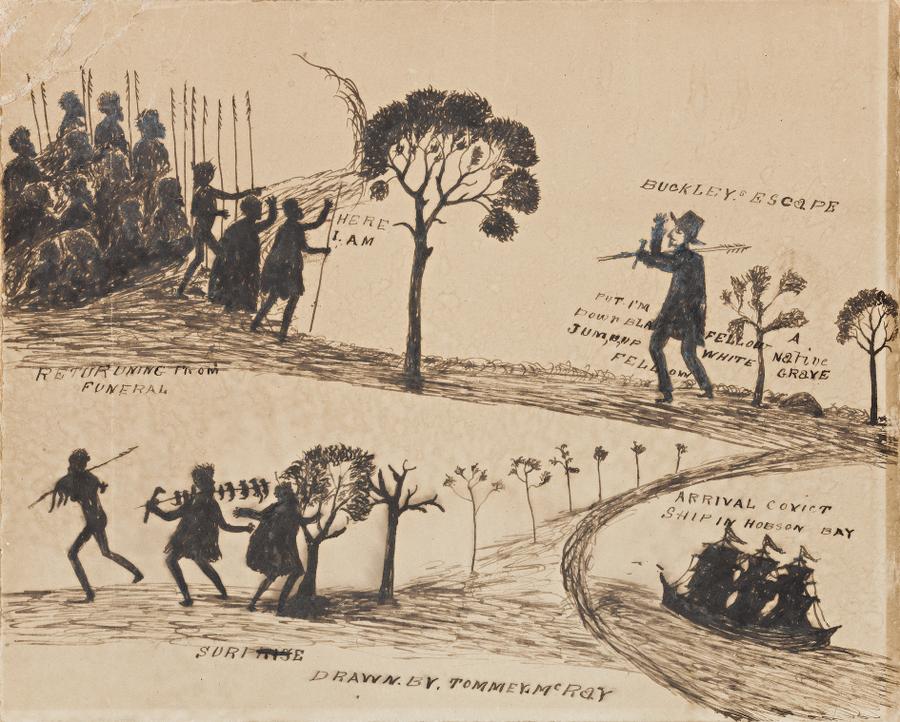
The Incredible Story of William Buckley Part 3 Today’s podcast covers most of the time Buckley spent living with the Wathaurong people, about 25 years, as they roamed around South-Western Victoria.  I’ve basically summarised a lot of the highlights of this time as related in the book The Life and Adventures of William Buckley. I would like to footnote this episode by mentioning a couple of things first.  There was an ample amount of internecine violence between the various groups of aboriginal people Buckley lived and interacted with during this time and he talks of having witnessed both cannibalism and infanticde.  I have seen some sketchy far right Twitter accounts using these facts as justification for their racist ideologies in which they make sweeping assumptions about the inferiority of aboriginal culture. I want to make it absolutely clear that I do not hold these views.  Furthermore, the book itself was ghost-written by John Morgan, whose own racial prejudice is clearly documented in its preface. One must remember that he has coloured much of its contents with this prejudice. Nevertheless, I think it would be remiss of me not to report the important details of the book and so I have included them here, but it may well be that the Wathaurong account William Buckley, or Murrangurk as they called him, differs in some respects.

As the years passed, Buckley started to develop an understanding of the Wathaurong language which he was patiently taught by his clan.  He learnt that they believed he had lost his language ability due to his experience of having died and returned from the spirit world They spent some time in the area between the Barwon River and the sea, hunting kangaroo.  By now, the affection he had with his people had grown, as they always treated him kindly, giving him the choicest pieces of kangaroo meat during meal times. He learnt how to throw a spear or tomahawk and skin the kangaroos and possums with mussell shells.  His friends taught him how to hunt salmon and bream at night in the Barwon River. They would tie some sticks in a bunch and light one end of it. The fish would be attracted to the light and then they would be speared in abundance.  

One day a large group about 300 men from a neighbouring aboriginal group, the Wurundjeri, arrived in their area.  The group were considered the enemy of the Wathaurong and as a result they a battle commenced between the two. Even the women from the Wathaurong joined in in the fighting, with two of them being killed.  After about two hours of fighting the two groups negotiated a tentative peace and the Wurundjeri retreated. But, the men from the Wathaurong secretly followed them and discovered their camp. The Wathaurong waited until the Wurundjeri had retired to sleep for the night before attacking them.  After the attack 3 Wurundjeri men lay dead and the rest ran away into the night, but it was what happened next that most horrified Buckley. The Wathaurong mutilated the corpses of the Wurundjeri, Buckley related it thus: 

“The bodies of the dead they mutilated in a shocking manner, cutting the arms and legs off, with flints, shells, and tomahawks.  When the women saw them returning, they also raised great shouts, dancing about in savage ecstasy. The bodies were thrown upon the ground, and beaten about with sticks – in fact, they all seemed to be perfectly mad with excitement; the men cut the flesh off the bones, and stones were heated for baking it; after which they greased their children with it, all over.  The bones were broken to pieces with tomahawks, and given to the dogs, or put on the boughs of trees for the birds of prey hovering over the horrid scene. Having apparently gratified their feelings of revenge, they fetched the bodies of their own two women who had been killed; these they buried with the customary ceremonies.”

Time passed and Buckley’s clan moved on to a lake by the the name of Yawangcontes, today called Lake Murdeduke.  Here they settled in huts for about 2 years before being contacted by a nearby aboriginal group who invited them to a much larger nearby lake called Kongiadgillock, or what is today called Lake Corangimite.  Within this large lake there was an island on which nested many Black Swans. The island could be reached from a bank of the lake at a kind of isthmus in only knee-deep water. Here Buckley’s clan gorged themselves on thousands of swan eggs, having been allowed to do so by the other aboriginal group.  They also butchered and roasted many swans. Afterwards they also invited Buckley’s clan to a corroboree, where, there occurred the usual fight over a woman from the other group who had gone with a man from Buckley’s group.  

As time passed Buckley’s clan moved from lake to lake and it was at the aboriginal people called Moodewarri, today known as Lake Colac, that Buckley saw the mythical Bunyip.  For non-Australian listeners, the Bunyip was a mythical beast that inhabited Rivers throughout Australia. It was said to have supernatural powers and to attack eat humans from time to time.  Buckley claimed to have witnessed one in the following account from his biography:

“In this lake..is a very extraordinary amphibious animal, which Bunyip, which apeared to be covered with feathers of a dusky grey colour.  It seemed to be about the size of a full grown calf; the creatures only appear when the weather is very calm, and the water smooth. I could never learn from any of the natives that they had seen either the heard or tail, so that I could not form a correct idea of their size; or what they were like.”  

After their time at the lake Buckley a messenger visited the group with a message from another mob to visit them.  It took Buckley’s mob 14 days to trek the distance to wear the others were located as was determined by the number of red stripes Buckley painted on his arm for each passing day.  Here a woman from Buckley’s mob was speared in retribution for having run off with a man from the other mob. 

Afterwards the group travelled to Beangala, now known as Indented Heads.  While here he experienced the biggest hailstorm he had ever encountered. Around this time also, Buckley was beginning to master the Wathaurong language.  He learned during his time here what had happened to one of the other escapees he had left Sullivan Bay with, from the book, quote:

“It seemed, that one of them, having, after a few days, separated from the others, was found by the natives and kindly relieved by them; but after some time, they – as it was said – had reason to be jealous of him – he having made too free with their women – so they killed him.”

It should be noted here that, this account by Buckley, given much later in 1853, differs markedly from an account he gave to George Langhorne just a year after he returned to Western society, in 1836.  In it he is quoted giving the following account: “I had lived with this tribe about six months, when I fell in with one of my companions, whom I found had been living with another family of the tribe on the sea coast. He then came and lived with me, but from his reckless conduct with the women and dissolute behaviour, I was fully convinced that if he remained one or both of us would be murdered. I therefore told him that it was necessary for the safety of both parties that one or the other must leave. He left, and I never saw him or heard of him again, except by a vague rumor – that he had been killed by the blacks, which I fully believe to have been the case.”  End quote.

The question arises here, which account is true?  Did he indeed fall in with his companion as he put it and ask him to leave, or did he just hear about his companion as he related in the 1853 book?  We may never know. It seems though that Buckley is a bit sketchy on this point. One wonders if there was a third possibility, that Buckley himself had something to do with his companion’s demise, we may never know the truth.

At this stage of the book, Buckley talks about some of the customs of the Wathaurong to do with marriage and child rearing.  A marriage must be agreed to by the parents of both the male and female in question. A male suitor must be able to prove himself a good fighter and hunter so as to be able to protect his wife.  A male may have a number of wives sometimes as many as five or six so long as he can look after them. Some men have no wives as a result of this.  

Quarrels are usually caused by jealousy and the women are just as prone to this as the men.  In the fighting however, the women usually come out worse off. Another thing he points out is that the meetings of the different aboriginal groups were not just for exchanging food, but also for showing off their eligible daughters to be seen and courted.

At this time Buckley talks of how a man from his mob went to that of another and murdered a man because he had years before promised him his daughter in marriage and then retracted the promise and married her to another man.  Buckley and some women visited the group in question to mourn together. The man was tied up in a tree as a form of burial. This incident and murder in general being such a regular occurrence unsettled Buckley and made him contemplate escaping.

Buckley’s group then went to Biarhoo on the Barwon River and then Godocut near the seaside.  The contemplated punishing the murderer as they worried about an impending revenge attack, but in the end decided against it.  Next they went to a place called Palac Palac and stayed for many months because there was plenty of animal food and fish. Eventually they noticed another group approach them and they feared it was the kin of the murdered man come for revenge.  But, a messenger was sent and it was not that group but a friendly mob and they were invited to share in an abundance of eels that had been found in a lagoon.  

At this point Buckley explains the native origin for the fire story.  A woman was digging an ant hill one day when a crow was flying overheard and dropped some dry grass and it burst into fire and burnt a tree.  For this reason they respect the crow which they call Waakee and rarely eat him.

The mob travelled to a place called Bordek where there were plenty of possums to eat.  Buckley’s brother-in-law taught him how to hunt the possums. He used his tomahawk to carve notches into a tree to make places to position his toes while holding his tomahawk in his mouth.  He would do this and gradually climb up the tree and pull possums out and fling them to the ground by their tails. Buckley’s job was to stand at the bottom and kill them.

The mob moved to Moriock (near Geelong) and here most of the males left to go on a hunting expedition leaving only 12 males and the females with Buckley.  Soon after they left, another group arrived and put up some huts very close to them. The mob were aggressive and used their numbers to their advantage to intimidate Buckley’s mob.  Eventually they killed a boy and a girl and Buckley’s mob, outraged, attacked them. There was a fight which lasted an hour. Eventually when it became clear Buckley’s mob could defend themselves, this other mob left.  A message was sent to the hunting party to return urgently which they did. A war council was set up and it was decided to pursue the offending mob for revenge. Only men were chosen for the pursuit and they returned with a number of men severely wounded, but it was considered a success because they had killed two of the other mob.

After some time passed Buckley’s mob moved to Barrackillock far to the north.  Another mob had already settled here. Buckley describes how a 20 year old woman from his mob was speared in the thigh for going with a man with the other mob and her parents did not agree to it.  The couple then eloped and revenge was planned on them.  

Here Buckley describes another animal called karbor, otherwise known as the (koala).  He describes how it tastes like pork, is ugly and mainly lives in the trees. It also made a sickening sound like a child in pain when it was speared.

After this the group went to Monwok.  Soon, the man and woman who had eloped were found and invited to participate in some sort of ceremonial battle.  The man’s mob and Buckley’s mob were in attendance. The man danced and capered challenging someone from Buckley’s mob to a fight.  Eventually someone accepted and they fought. The man from Buckley’s mob was winning and struck the eloper in the head so that blood was flowing from it.  The eloper’s mob stopped the fight there though and threatened a greater fight if it continued, so it stopped.

Later the mob came to a freshwater lake.  They saw another mob on the opposite shore during the day.  During the night they were awoken by a terrible commotion coming in the direction of the other mob.  In the morning they travelled to other side to investigate. Most of mob had been slaughtered by a third mob, many bodies of women and children were lying there mutilated.  Many of the attacked mob drowned in the lake fleeing. Buckley’s mob invited those who had survived to their huts and they accepted. There was no time to bury the victims. Buckley’s mob  and their new members left as it was dangerous and travelled to their usual country of Moodewari where they remained for several months.

Buckley relates how infanticide is carried out by the natives on illegitimate children or children of a woman who was first one man’s but then promised to another.  They also killedl children who are deformed. He saw the brains of one being dashed out by a blow to the head and the brother of the child made to eat them. There was a superstitious reasoning behind this act.  It was observed that the women behaved oddly during certain periods of the moon’s cycle. This was considered the reason for the deformity and therefore this cannibalistic rite had to be performed in some sort of sacrifice.  The boy’s father denied his being the father and it was said the other boy had to eat the brains so the same fate would not befall him.

Buckley tells the story of how after a long time at Moodewari another tribe joined them and woman of Buckley’s tribe was taken away by the other tribe until he was forced to give her up.  She was placed in Buckley’s hut, he wasn’t happy about this. In the night man came to hut and speared man from Buckley’s tribe who he was jealous of and kidnapped the woman. Buckley and victim’s brother tried to pull out the spear but could not because it was jagged.  Eventually a woman pulled the spear, but victim died later and was buried. Some men pursued murderer, but returned at night when they could not find him. Victim’s mother burnt her face with firesticks in lamentation. Shortly afterwards, Buckley’s tribe changed hunting grounds and fellin with tribe murderer belonged to.  Fight ensued. Buckley’s tribe could not find murderer so instead they murdered his 4 year old son by bashing his brains in. Also killed his brother and speared his mother through the thigh. Murderer himself came back at night and killed the man who had killed his brother, cut most of flesh from his body and carried it away on spears.   The tribe (which tribe not clear) signalled their joy at this revenge by by singing and dancing. Buckley requested to partake in cannibalism and refused to do so. Buckley was told it was their intention to serve all of the murderer’s tribe in the same way.

Buckley’s tribe settled near a lake called Koodgingmurrah.  Another fight occurred, as usual about women. Buckley nearly killed by boomerang that split his shield.  It was not meant for Buckley but for his brother in law. Man was punished despite Buckley’s protests. Buckley’s hand was wounded and the women bound it with possum felt and sinew.

Buckley says the aborigines love music and play on possum rugs and sticks.  The natives never wash and wear ornaments as rings and in their hair such as bones and teeth from animals and feathers from emu and swans.  

At opposite side of lake, ate mainly Kalkeeth (large ants) found in the hollows of trees.  Pulled out by hand and burnt or roasted on strips of bark. Only available one month of the year.  Mentions how the natives get the stone for making their axes from a place called Karkeen (Mount William about 230km inland), 300 miles inland.  The tribes who live in the area are savage so it was necessary to send a contingent of tough fighting men to fetch this necessary article.

Invited by other tribe to fish for eels at River called Booneawillock.  Another tribe arrived and another fight occurred over women. Buckley’s tribe continued to roam about after this.  One man was bitten by a snake while stepping over a tree and died immediately. Was esteemed high member of tribe and death caused great sorrow, was buried in tree.  

Eventually Buckley was left only with his immediate relations and 2 or 3 families of others.  A large tribe of 60 came upon them and painted themselves up as if for war. They came upon Buckley’s tribe and attacked killing his brother-in-law’s wife and sending a spear through brother-in-law’s body.  They came back to Buckley where he was caring for his injured brother-in-law. Brother-in-law sprung up and speared one in arm. Was immediately dispatched with spears and boomerangs as was his son. For some reason, they did not attack Buckley.  The cause of attack was that man who died of snake bite belonged to attacking tribe. Tribe believed Buckley’s brother-in-law had caused his death somehow. Buckley deeply affected by the killing of his relatives. He cried for a long time about it.  Buckley ordered by one murderer to join his tribe but he angrily refused. He wrapped up his spears and set out alone. After about 4 miles he fell in with a tribe he knew. Buckley told them about the murders and they vowed vengeance. Before they set off they told Buckley where to remain once they had returned.  He set off for the place near Barwon River. 5 women returned few days later, said was great fight, friends had avenged killer of brother-in-law, but women left because danger of being captured. Women left Buckley after few days. Buckley then went to scene of massacre of his family. Found the ashes of family and buried them.  Then went back to Barown River and men returned next day. Asked Buckley to join their tribe, but he refused as was depressed following murder of family and did not trust them to avoid violence. They left, next day Buckley left in opposite direction toward sea. Reached place called Mangahawnz. Set up hut and lived alone for months.  Had now been living in the wild for more than 25 years.  

Had learnt from natives, Calcutta left Bay many years before.  Often looked towards sea and hoped for ships, but never saw any.  Prayed often to God as lived a very lonely and miserable existence. 

The incredible story of William Buckley part 4
More on William Buckley

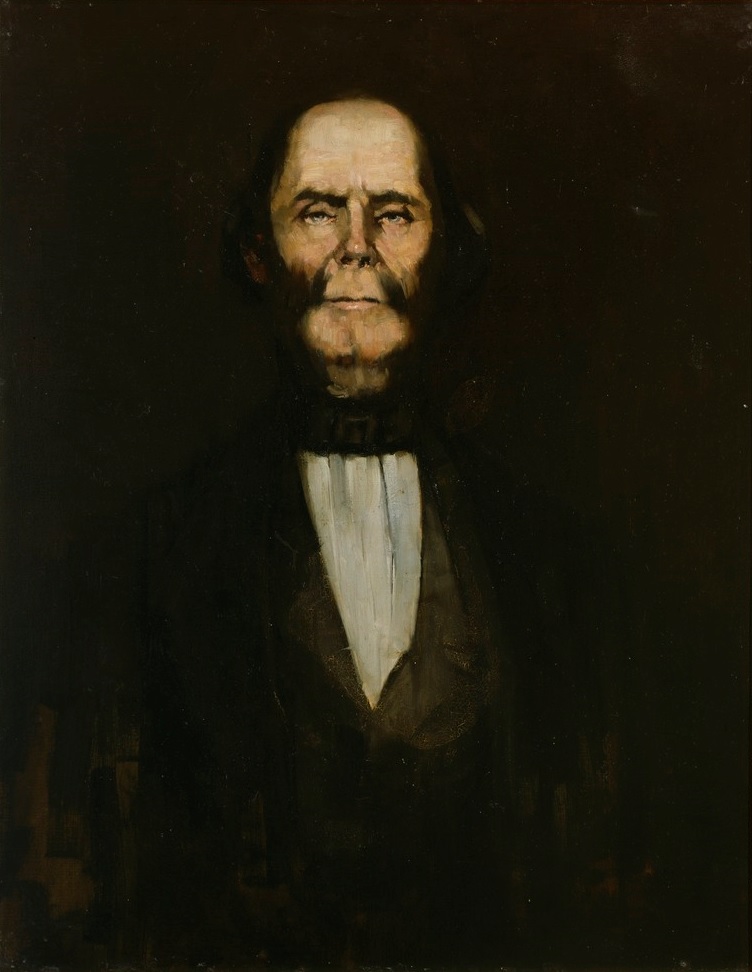
William_Buckley_portrait

The Incredible Story of William Buckley Part 2

The Incredible Story of William Buckley Part 2 – The tale of an escaped convict who lived in the bush for 32 years with the Wathuroung aboriginal people before the settlement of Melbourne.

Buckley stayed in the hut that had become his home for a few months in order to recover his health.  But, he soon grew lonely and longed for human contact. Just as he was considering leaving the area he was surprised one day by some human voices speaking a strange language.  Buckley looked up and was startled to see three aboriginal men armed with spears standing on an outcrop. He tried to hide, but the men discovered his tracks and called out to him.  Buckley emerged from his hiding place and the men stared at him in wonderment. They took his hands in theirs and struck both their breasts and his while making an unusual sound which was “bewteen singing and crying…a sort of whine which to me sounded very much like premeditated mischief”.  After examining Buckley’s hut the men then made a fire and threw some crayfish onto it alive. Buckley was worried they might want to cook him next but his fears were proved misguided when they gave him the first and best portion of the seafood.  

After eating, Buckley’s new friends gestured for him to follow them, which he did reluctantly.  Buckley, still feeling tentative about his new acquaintances hoped to escape at the first chance he got, but, while two of the men went on ahead, the one that was left with him watched him like a hawk.  After arriving at some huts made of turf they turned in for the night and Buckley thought this might have been a good opportunity to abscond, but his guard stayed in the tent with him and didn’t sleep at all muttering to himself the whole time.

In the morning the men seemed to beckon Buckley to follow them once again, but this time he refused to go further.  The men reluctantly accepted these conditions, but tried to get Buckley to part with his old, worn stockings. Buckley refused this too though and they accepted after quote “sundry striking of breasts and stamping of feet”.  As Buckley was considering what he might do next, one of the men returned with a crude basket made of rushes, which had the berries mentioned previously and attempted to exchange this for his stockings. Buckley again refused and the man, dejected, went on his way.  

When night came Buckley cursed having left the men because he had no fire to warm himself.  Therefore, he returned to where he thought the huts were, but they were no longer there. Suffering from exposure, he desperately tried finding the aboriginal men by making out in the direction he thought they had left in, but after a while, he became completely lost, and exhausted, lay down under a large, hollow tree.    Luckily he found a firestick nearby and made a fire which attracted dingoes and possums and he couldn’t sleep because of the howling of the former. 

   For a while Buckley travelled around by himself subsisting on anything he could find such as the fruit the men had brought him and shellfish.  Eventually, a desire for comfort brought him back to his old cabin on the beach and he remained here many months.  

As the weather had become very cold and stormy by this stage and as his clothes had become worn and tattered, Buckley eventually resigned himself to attempting to return to the ship.  He bade farewell then and began to retrace his steps back along what is now the location of the Great Ocean Road.  

By this time Buckley was becoming extremely weary and could only make short distances each day.  After a few days he arrived at a creek the natives call Doonagawn and made himself a simple shelter in the vegetation.  Although he didn’t realise it at the time, here Buckley was to make a fortuitous discovery that was to have a considerable impact on the rest of his life.  Right next to where he had made his shelter Buckley found a mound with a spear thrust into it. He immediately realised it was a native grave. But, in his weary state, Buckley simply saw the spear as an excellent potential walking stick and thought nothing more of it at the time.  The next day he reached the Karaaf River and tried to cross it, but weak as he was, he was unable to and he was carried downstream some distance, before eventually reaching the other side where he collapsed in a heap, exhausted. Drenched, he lay down in the scrub freezing and lamented his condition.  He prayed long and hard into the night as the dingoes howled around him and he fully expected to be eaten by them before morning.  

The next day he came across a lagoon the Wathaurong called Maamart.  While he was searching for gum a group of aboriginal people appeared out of the bush and approached him.  They seemed to be overcome with emotion at seeing him. The men took him by the hands and beat their breasts and his in a gesture that he assumed was a greeting.  The women assisted him to walk while making terrible wailing noises and pulling clumps of hair from their head.
They took Buckley to their huts and gave him some sustenance in the form of a pulp made from gum and water which Buckley greatly enjoyed.  They called Buckley Murrangerk, who he later found out was the man whose grave he had taken the spear from. Much later Buckley learnt that the aboriginal people believed that white people were the spirits of people who had died.  In cases in which they had killed white people it was because they had believed the white people to be the returned spirits of their enemies. Buckley felt great fortune at his situation because if he had not picked up the spear when he had, he may have died.

As it was, the people were extremely kind to him.  They went away and found some moth grubs to give him sustenance and he was surprised at how tasty they were.  Buckley stayed with them all night and was still a bit scared of what they might do to him, but was too weak to escape.  The women spent the night wailing and inflicting wounds on their faces and pulling the hair from their heads. Buckley was shocked by this, but later he found out that this was a custom they performed when someone died or when someone returned having been away a long time.  They were expressing their grief at the pain Buckley must have undergone when he died.  

The next day Buckley’s new companions took him to the main body of the tribe on the other side of the Barwon River.  Here there were upwards of one hundred people who made a great commotion on Buckley’s arrival with the usual beating of breasts by the males and the pulling of hair from their heads of the females.  In order to welcome Buckley the people held a great Corroboree. At the time, Buckley was still anxious as he was not sure whether they wanted to cook him, but this didn’t prove to be the case as he relates thus:

“then there was a great noise amongst them, and a trampling backwards and forward from hut to hut, as if something of importance was going on.  I was naturally anxious at this, not knowing how it would all end; at last it came on night, and the boys and girls set to work making a very large fire, probably to roast me – who could tell? At any rate I supposed it not at all improbable, surrounded as I was by such a host of wild uncultivated savages: however that might be, it was impossible to escape, as I was too weak and terrified at the appearance all around.  At last all the women came out naked – having taken off their skin rugs, which they carried in their hands. I was then brought out from the hut by the two men, the women surrounding me. I expected to be thrown immediately into the flames; but the women having seated themselves by the fire, the men joined the assemblage armed with clubs more than two feet long; having painted themselves with pipe-clay, which abounds on the banks of the lake.  They had run streaks of it round the eyes, one down each cheek, others along the forehead down to the tip of the nose, other streaks meeting at the chin, others from the middle of the body down each leg; so that altogether, they made a most horrifying appearance, standing round and about the blazing night fire. The women kept their rugs rolled tight up, after which, they stretched them between the knees, each forming a sort of drum. These they beat with their hands, as if keeping time with one of the men who was seated in front of them, singing.  Presently the men came up in a kind of close column, they, also, beating time with their sticks, by knocking them one against the other, making altogether a frightful noise. The man seated in front appeared to be the leader of the orchestra, or master of the band – indeed I may say, master of the ceremonies generally. He marched the whole mob, men and women, boys and girls, backwards and forwards at his pleasure, directing the singing and dancing, with the greatest decision and air of authority. This scene must have lasted at least three hours, when, as a wind-up, they gave three tremendous shouts, at the same time pointing to the sky with their sticks; they each shook me heartily by the hand, again beating their breasts, as a token of friendship.  By this time I was greatly relieved in my mind, finding no injury to me was contemplated, and particularly when they all dispersed to their huts, and I was left again with my guardians.”

The next day Buckley was to quarter with the brother of the man they believed him to be and his wife and son.  

That night there was another great Corroboree, but Buckley retired to the hut of his new acquaintances.  They entertained him with roots and possum meat which was a great feast for him because he had not had meat since he had left the Calcutta.  He was presented with a possum skin-rug after which he presented his “brother’s” wife with his old worn jacket and this greatly increased the affection which the family showed him.

In the morning there was an argument and some men began brandishing their spears.  After a great deal of swaggering the two groups of men actually began fighting and when Buckley’s relations saw this they took him away and observed from a distance.  One man was speared in the thigh and a woman from the group Buckley was associated with was speared under the arm and killed. Eventually peace was restored and everyone retired except about 20 of the members of this woman’s tribe, who made a fire and threw her body on it.  When there was nothing but ashes they piled them together and stuck her digging stick into it.

After this, everyone went away except Buckley’s relations and one other family.  They went to another part of the bush and remained there some considerable time. They ate roots mainly, which the women sought daily and occasionally the men would kill a possum.  Sometimes they killed kangaroo and Buckley found this meat delicious. After a few weeks they joined another tribe of about 50 and had a Corroboree on the evening of their meeting, but during the festivities there was a fight and two boys from the other group were killed.  Buckley couldn’t understand what these quarrels were about, but understood later that it was because one tribe had taken women away from the other tribe. At other times, women willingly left their husbands to join other men, which gave rise to jealousy. When the fights occurred, Buckley was always kept in the rear for his protection.  When the fracas was over the tribe to which the boys belonged retired into the bush and Buckley’s people set up huts from branches and bark. Suddenly in the night the other tribe attacked them again and took the bodies of the two boys who had been killed from a hut. They cut off their legs and thighs and took them away. Buckley’s tribe retreated and the remains of the boys were burnt in the usual way.

Afterwards, Buckley’s people went to the coast.  From here a message was sent to the other group with whom they had had the earlier fracas about the women.  They challenged them to a fight at a designated place to settle the matter. After 4 days the messenger returned to say that the other tribe had accepted the challenge and they went there, but Buckley was not aware at the time of the reason why they were going there.  They arrived at the meeting spot about 20 miles away, where about 5 tribes were gathered and the fighting commenced. The fighting lasted about 3 hours after which 3 women lay dead. Buckley says in these fights the women usually faired worse off. The quarrels alarmed Buckley because the participants often pointed towards him during the fighting as if he was the source of the dispute so he again started to worry that he might be sacrificed.  

Eventually Buckley’s tribe returned to him and encircled him before escorting him to the clearing where the fight had been and where the other tribe were waiting in a square-shaped guard.  Buckley was worried he’d be killed. There was silence and they all stared at him. They then began muttering and shaking their spears and gave 3 shouts and eventually returned to their respective huts.
In the morning Buckley found the other tribe had gone and his tribe returned to the place they usually occupied and remained there for a very long time unharmed.  After a while a messenger came from another tribe saying they were to meet them some miles off. Their method of marking time was by marking days on the arm in chalk and rubbing one off as each day passes.  After travelling two or three days they met the other tribe and Buckley had never seen them before and they had a great corroboree that night.  

The next morning the two tribes had a big kangaroo hunt.  Buckley was very interested in participating as it was his first and they conducted it with great skill.  They killed several big kangaroos and had them roasted that night. The next day there was a big argument between the two tribes over two of the women.  This time though it didn’t end in bloodshed. Afterwards, the tribes separated and each went to its own area.

More on William Buckley

The incredible story of William Buckley part 3

The Incredible Story of William Buckley Part 1

The Incredible Story of William Buckley Part 1 – The tale of an escaped convict who lived in the bush for 32 years with the Wathuroung aboriginal people before the settlement of Melbourne.

In 1803, when the transportation of British convicts to Australia is at its height. An attempt is made to start a settlement in Port Phillip Bay at modern day Sorrento. The mission is doomed to failure because of a lack of an adequate water supply, but before it relocates to Van Diemen’s Land and starts the settlement of Hobart Town, a handful of convicts escape their captivity by fleeing into the bush. Among them is a 6ft 5, 23 year old, former soldier named William Buckley. With the nearest sign of civilization at the time being the convict colony at Sydney, more than 850 kilometres away and with no maps or supplies the men are given up for dead.  

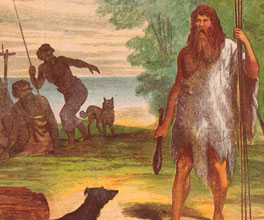
Later, when the settlement of Melbourne has just begun, and a basecamp for the settlement has been set up at Indented Head on the Bellarine Peninsula to await the return of supplies from Van Diemen’s Land, a stranger walks into the campsite. Whoever it is is a giant of a man. He has long white hair and a long white beard. He’s dressed in possum furs and carries two spears. It is William Buckley. He’s been away from civilization for so long he’s forgotten how to speak English.

This is 1835, he’s been living in the wild with the Wathaurong aboriginal people for 32 years

In researching this story I’m relying largely on the 1852 biography ghost written by John Morgan called The life and adventures of William Buckley : thirty-two years a wanderer amongst the aborigines of the then unexplored country round Port Phillip, now the province of Victoria.  It is the longest and considered the most authoritative source of Buckley’s life. However, it differs in some key respects to some other much shorter, contemporary accounts of the time which I we will discuss at the appropriate time..  Others criticise Morgan’s account for over embellishing certain aspects of Buckley’s story, however, historians tend to agree that Morgan’s account, as it is written in Buckley’s own voice, is the most accurate account we have. 

However, I will say it is impossible to know for sure the truth of all the events that occurred as we are reliant on the veracity of Buckley’s story and the integrity of Morgan to avoid using creative licence. Ultimately, I think it is up to the reader as to how much of the story they should take for fact.  The account would certainly reads as controversial to modern eyes in some respects. Particularly in its representation of the constant warfare and violence between the aboriginal ‘tribes’. There are also a number of accounts of cannibalism detailed amongst them and certainly the way this is represented by Morgan is in a extremely patronising way as he clearly looks down on what he regards as the uncivilised nature of the aboriginal savages and comes across as racist to a modern reader.  

William Buckley was born in 1780 in Macclesfield, Cheshire, England.  He had two sisters and a brother and his parents were farmers. He was adopted by his mother’s father and at the age of 15 was apprenticed as a bricklayer to a Mr Robert Wyatt.  Buckley clearly didn’t enjoy this lifestyle because at the age of 19 he ran away and joined the Cheshire Militia.  He describes receiving a bounty of ten guineas for this and remembers thinking this amount of money would last him forever.  

After a year, his money had exhausted and he volunteered in the King’s Own Regiment of Foot at Horsham in the south of England a long way from his native Cheshire.  After only 6 weeks here his unit was ordered to to embark for war in Holland where the Duke of York was in battle against the French Republic.  Buckley’s regiment under the command of the Earl of Chatham suffered heavy losses in this battle and Buckley’s hand was severely injured although he doesn’t detail how this injury occurred.  

On returning to England Buckley received another bounty for extended service.  His officers had a good opinion of him because of his height, he was six foot five, and his good conduct.  But, soon afterwards he fell in with a bad crowd he had met in the regiment and was arrested for receiving false goods. 

Buckley always maintained his innocence in this affair saying that a woman asked him to collect some items for her and then he was arrested by authorities for receiving stolen goods.  He was found guilty in court and after this sentence he never heard from his family again.  

As a prisoner he initially worked on fortifications being built at Woolwich, but as a mechanic he was identified as possibly being useful to a new penal colony that was to be set up at Port Phillip in what was then New South Wales.  

Buckley saw this as an excellent opportunity to redeem his sullied name and so he embraced being sent for transportation to the other side of the world.            This is noteworthy when you consider the hardships that often went hand in hand with a marine trek to the Antipodes. 

A journey from England to what was called New Holland at the time took the best part of a year to complete and trips were arduous affairs that often involved the deaths of upwards of 10% of those who embarked.  

This is not to mention the exceptional remoteness of the colony.  The convicts were expected to build infrastructure when they arrived in a complete wilderness.  This says a lot about Buckley’s character that he was willing to embrace his transportation in order to redeem himself. 

On top of this, prisoners were often treated cruelly in a time when severe punishments were the rule.  Lieutenant Colonel David Collins was chosen to lead the expedition and to be the governor of what was to be the first settlement in modern day Victoria.  They set sail in two ships, the Calcutta and the Ocean.Buckley was treated well on the journey and spent most of the time helping out the crew. 

When they arrived the ships anchored 2 miles within the heads at a place Collins named Sullivan Bay. This site was chosen as a penal settlement because it was over 600 miles from Sydney which meant escape would have been practically futile.  

The marines and convicts landed and encamped and Buckley mentions how, while most of the convicts had to camp inside a line of sentinels, he and the other mechanics were permitted to camp outside it and were set to work on the first buildings of the settlement.  

Life, though, was tough at the new settlement.  There was no access to a reliable fresh water supply and the soil proved poor for growing crops. So, after 3 months of roughing it Buckley and 3 others decided to make an escape from their bondage. 
Buckley in 1852 freely admitted to the madness of this plan, as it involved walking to Sydney 600 miles to the north.  

With no maps though and no idea which direction Sydney lay in, the attempt was utterly pointless and perhaps speaks of the desperation he felt at the time, especially considering the settlement was attempting to survive on brackish seawater. 
Buckley and his 3 companions had been entrusted with a gun to shoot kangaroo in the area they were working in.  

One dark night they absconded with the gun, an iron kettle and as many supplies as they could take.  They were spotted however, by a sentinel who shot at them, taking down one of Buckley’s companions.  He never found out if this man survived as he never heard from him again.

In fear for their lives the 3 remaining men ran for 3 or 4 hours before stopping for a break. Not long after renewing their march they came to a river now known as Balcombe Creek in Mouth Martha.  

At daylight they began to renew their trek when they encountered a party of natives.  This was the first encounter Buckley had with any of the natives that we know about.  He says he fired the gun in order to scare them off and they ran into the bush.

Buckley crossed first to test the depth and then helped the others across and went back for their clothes.

That night they reached to about 20 miles from the modern city of Melbourne and rested there until the morning when moved on again until they crossed the Yarra River a few hours later.  

They crossed the river and continued their way up the Mornington Peninsula crossing the Yarra River the next day.  After this, they headed away from the coast and travelled through vast plains until they reached the Yawang Hills (today knows as the You Yangs).  Here they finished the last bit of bread and meat they had taken with them.  

As they were incapable of finding any food Buckley told his friends they must return to the bay to find shellfish or they would die of starvation and they agreed so they returned to the coast after what Buckley called  “a long and weary march.”

They were able to subsist off shellfish, travelling down the west coast of Port Phillip Bay through the areas of modern day Corio and Port Arlington.  But, life was becoming a serious struggle.  Water was hard to come by and the only thing they had to eat was shellfish and which caused the men to suffer from diarrhea.

By this stage the men had been gone for a few days. There were thirsty, tired, suffering from diarrhea and they had started seeing native huts dotted about the place.  

The indigenous people who lived in the area at the time, known as the Wathaurong people, were a nomadic hunter-gatherer people much like the other Australian indigenous peoples.  They would often build these temporary huts made from bark and tree branches and then they would abandon them or perhaps come back to them at a later date. So, these 3 European men were seeing these types of huts around the place, but they were not occupied.

2.3.3.3_00

Buckley and his companions must have felt great fear at the prospect of bumping into these tribes as they referred to them.  The common early 19th century trope that was in the backs of their minds was that these were untamed savages who would eat them as soon as greet them, so it can be imagined that they were somewhat concerned about this inevitable meeting. But, apart from the meeting they had had on their second day from the settlement on the other side of the bay, in this area they were only encountering vacant huts.  

The next day they reached an island the Wathaurong called Barwal, which is called Swan Island in modern parlance.   Buckley mentions how they could reach the island during low tide.  Even today if you look at Swan Island on Google Maps you’ll see that the island is separated from the mainland by a very narrow strait of water. 

Melbourne sits on the Northern tip of a large bay, but the point of entry to the bay is a very narrow strait at the Southern end.  The Calcutta had anchored just inside the Eastern head of the bay and so the 3 escapees had walked around the entire length of the bay from the eastern head to the western head a journey of well over a hundred and close to two hundred kilometres.  From Swan Island which lies just inside the Western head of the bay they could actually see the Calcutta at anchor on the other side as the bay considerably narrows the closer to the Heads you get.   So, these men were exhausted, dehydrated and hungry, and in their minds they were in danger of being captured and potentially eaten by roaming packs of savages.  

Suddenly the prospect of returning to the settlement started to look appealing.  Sure they might be punished, they might have their sentences lengthened, but at least they would have a roof over their heads and something to eat and drink, and didn’t have the threat of being cannibalised at any moment hanging over their heads.

Buckley relates what happened next:

“The perils we had already encountered damped the ardour of my companions, and it was anxiously wished by them that they could rejoin her (meaning the Calcutta), so we set about making signals, by lighting fires at night, and hoisting our shirts on trees and poles by day.  At length a boat was seen to leave the ship and come in our direction, and although the dread of punishment was naturally great, yet the fear of starvation exceeded it, and they anxiously waited her arrival to deliver themselves up, indulging anticipations of being, after all the sufferings they had undergone, forgiven by the Governor.  These expectations of relief were however delusive; when about half way across the bay, the boat returned, and all hope vanished. We remained in the same place, and living in the same way, six more days, signalizing all the time, but without success, so that my companions seeing no probable reply, gave themselves up to despair, and lamented bitterly their helpless situation.”

Buckley goes on to relate how at the end of the next day, his companions decided to retrace their steps round the bay and return to the settlement.  He spells it out thus:

“To all their advice, and entreaties to accompany them, I turned a deaf ear, being determined to endure every kind of suffering rather than again surrender my liberty.  After some time we separated, going in different directions. When I had parted from my companions, although I had preferred doing so, I was overwhelmed with the various feelings which oppressed me: it would be vain to attempt describing my sensations.  I thought of the friends of my youth, the scenes of my boyhood, and early manhood, of the slavery of my punishment, of the liberty I had panted for, and which although now realized, after a fashion, made the heart sick, even at its enjoyment. I remember, I was here subjected to the most severe mental sufferings for several hours, and then pursued my solitary journey.”

Now you may be wondering at this point what Buckley was doing on the Western side of Port Phillip Bay considering he was trying to reach Sydney.  The elder Buckley wonders this himself in 1853 and reflects at how futile the quest of his younger self was.

On the first day of his solitary wanderings one of Buckley’s greatest fears was realised in that he encountered a group of about 100 aborigines in and near some huts made of bark and branches and some of them made towards him.  Fearing for his life, Buckley jumped into a river with his clothes on whilst carrying his firestick. Luckily the natives didn’t follow him into the river, but in quickly jumping into it all his clothes were drenched and he had no longer any means by which to start a fire to keep warm.  He had to sleep on the bank of the river that night in wet clothes in early Spring, which must have been close to unbearable.

The next day he returned to the beach making sure he wasn’t seen by the natives.  As it was low tide, he found lots of abalone which the natives called Kooderoo. He continued on up the coast, subsisting on what the Watharoung called Kooderoo, which we know as abalone, which was abundant in the area.  He passed through the Karaaf River and the River that pass through modern day Torquay at the beginning of what is today the Great Ocean Road. Buckley was just travelling further into the wilderness. 

Adding to Buckley’s suffering throughout this time was the fact that water was hard to come by.  On top of this, when he ate the abalone it made him thirstier. He would have to rely on the dew that collected on the branches in order to survive. 
If we look at the direction Buckley was travelling in at this point we will see that he was actually going in the opposite direction of Sydney, his supposed destination.  Sometimes he would spot the abandoned huts of the natives. At others he would see wild dingoes and their howlings haunted him at night.

He continued travelling along the coastline in a South-Westerly direction passing through the areas of modern day Angelsea and Airey’s Inlet.  Luckily he found the natives had been burning the bush here and managed to procure a firestick for himself. At this location he also found a native well, some berries in bushes and a great supply of shellfish which he was able to cook on his new fire.  Buckley talks of giving up great thanks to God for this because he had been growing weak all the time due to the conditions he had been living under.

He continued on down the coast and two days later came to Mt. Defiance which the natives called Nooraki.  Here he decided to settle down for a while as his body had begun to break out in strange sores, probably as a result from suffering from scurvy from malnutrition.  He created a more permanent shelter and found some edible plants nearby that could sustain him and stayed in the area for a few months.

To continue this story, click on the next blog post here: The Incredible Story of William Buckley Part 2

Eamonn Gunning 2017

William_Buckley_portrait